
The short version
- Latest reading: 56.1% on the City's daily figures for 21 October 2026. A year ago Voëlvlei was 99.3% full.
- Voëlvlei feeds the higher parts of Durbanville. Wemmershoek and Blackheath water reaches the town too, through one connected network.
- The whole system decides restrictions, not one dam. It stood at 74.0% on 19 October, and the national water department meets on 2 November to consider restrictions. We will update this post after the meeting.
- When the Voëlvlei plant shuts, the City fills its reservoirs first and asks for lower use. Pressure that dips during a shutdown and recovers afterwards is likely that. Pressure that stays weak is worth a gauge reading.
- The City wants households to use at least 10% less this summer. A silent leak is the first place to look.
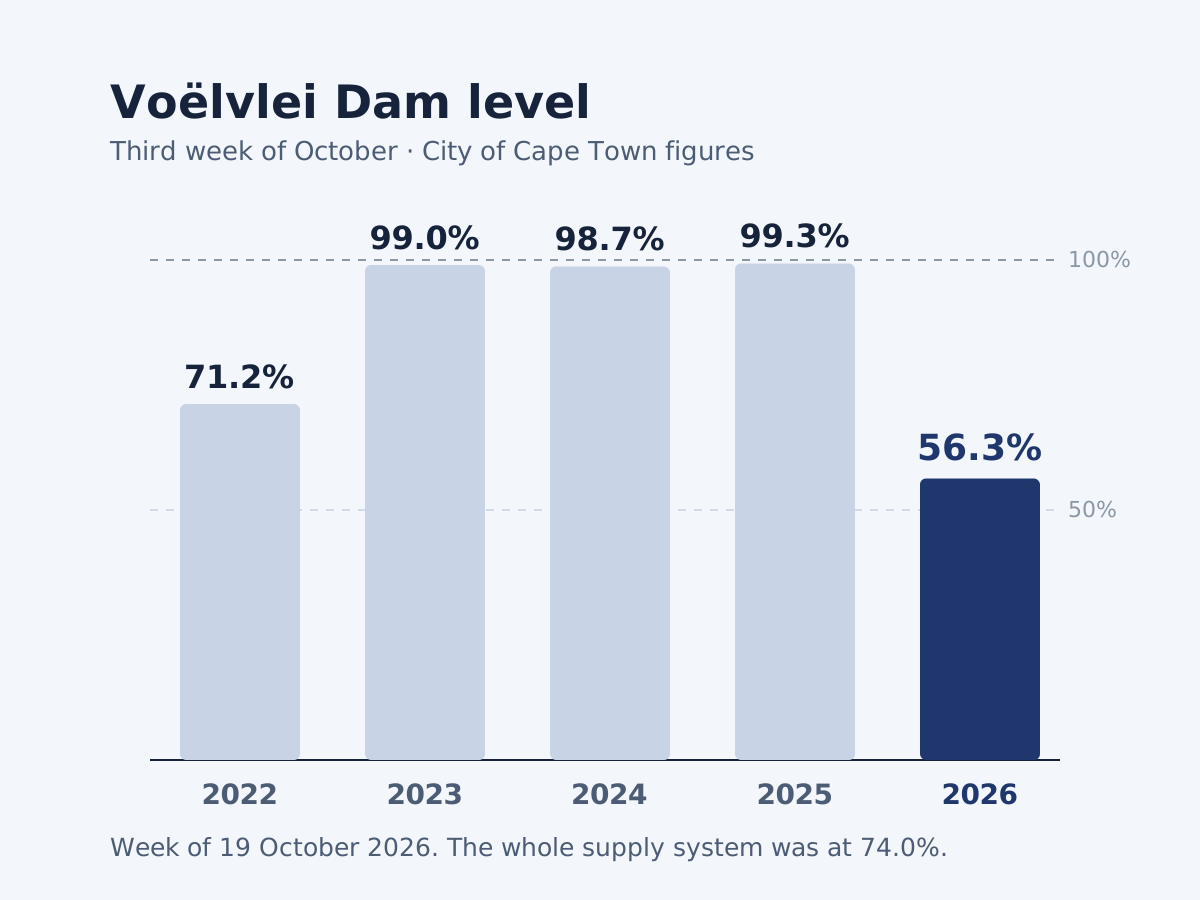
The Voëlvlei Dam level was 56.3% in the City of Cape Town's figures for the week of 19 October 2026. In the same week last year it was 99.3%, and of the six big dams in the supply system only Lower Steenbras, at 48.3%, is lower now. Voëlvlei feeds the higher parts of Durbanville, but the City runs its dams as one system, so what decides this summer is the system total of 74.0% and the national water department's meeting on 2 November.
This guide is written by Durbanville plumbers for homeowners who want the plain version: where Durbanville's water comes from, why Voëlvlei has fallen so far, what happens at your tap when its treatment plant shuts, and what the 2 November meeting could change. We will update it once the meeting's outcome is published.
Does Durbanville get its water from Voëlvlei Dam?
Partly. The City's last published map of its supply areas, in its 2019/20 drinking water report, lists Durbanville under three treatment plants: Voëlvlei for the upper areas, Wemmershoek, and Blackheath. The City calls those areas approximate, because water is moved around the network depending on dam levels, the season and maintenance. Its 2024/25 report describes the plants as feeding "an interconnected system of reservoirs and pipelines".
The City's own alerts show which parts of town lean on Voëlvlei. When it shut the Voëlvlei plant for a day in April 2024, its notice said the work would affect the reservoirs supplying Durbanville, naming Uitzicht, Pinehurst and Sonstraal Heights. Durbanville itself sits in the Tygerberg Hills, between about 100 and 240 metres above sea level.
The route is a long one. The City's Voëlvlei Water Treatment Works draws straight from the dam through a low-lift pump station, and a high-lift pump station sends the treated water to the City along the 80 km Voëlvlei pipeline, according to the published description of the supply scheme. The City's 2024/25 report lists the Voëlvlei supply at a maximum of 273 megalitres a day.
Voëlvlei Dam level today, and how far it has fallen
The City publishes daily and weekly readings on its dam levels page, with a longer weekly water dashboard alongside. The latest figures:
- 21 October 2026 (daily reading): 56.1%.
- Week of 19 October 2026: 56.3%, down from 57.7% the week before.
- The same week in earlier years: 99.3% in 2025, 98.7% in 2024, 99.0% in 2023 and 71.2% in 2022. This October is the lowest of the five.
- Full capacity: 164,095 megalitres, the second-largest dam in the system after Theewaterskloof.
In volume, 56.3% of Voëlvlei is about 92,400 megalitres. At 99.3% a year ago it held about 163,000. That is roughly 70,000 megalitres less going into summer, our arithmetic from the City's figures.
We keep this reading current
We update the latest reading at the top of this post whenever we revise it, including after 2 November. For the figure on any given day, the City's dam levels page is the source.
Why the Voëlvlei Dam level is so much lower than last year
Voëlvlei works differently from most of the big dams. It was built in 1952 to enlarge a natural lake, and the scheme description calls it an off-channel dam with a catchment of only 38 square kilometres of its own. Most of its water arrives through two canals that divert river flow in winter: one from a weir on the Klein Berg River, the other from weirs on the Twenty-Four Rivers and the Leeu River.
That makes it a winter dam. The canals fill it while the rivers are running, and it gives water out through the dry months, so how full it gets depends on the winter. The City's weekly water dashboard for 19 October says rainfall since May 2026 has been below expected levels, leaving the system's storage roughly 15% lower than at the same time last year. The storms of 10 to 14 May lifted most of the other big dams sharply, but Voëlvlei only went from 50.28% before them to 59.63% on 1 June. It is lower now than it was then.
A longer-term fix is planned. The Berg River Voëlvlei Augmentation Scheme will pump winter water from the Berg River into Voëlvlei, adding 23 million cubic metres a year to the system, with 15 million of that allocated to the City. As at May 2026 it was still in the preconstruction stage, with water delivery now expected in May 2030, Engineering News reported. It will not help this summer.
What a Voëlvlei shutdown looks like at a Durbanville tap
The dam level is one thing. The treatment works is another, and it is the works that Durbanville notices. The City has listed work on the Voëlvlei plant or its pipeline in five different months of the past year. The planned shutdowns of the plant itself:
- 15 to 20 September 2025: a maintenance shutdown, with residents and businesses in Durbanville among those named as affected.
- 23 to 25 March 2026: planned work on the treatment process. The City filled its reservoirs in advance and asked Durbanville residents and businesses to use less water while the plant was off.
- 12 to 13 October 2026: servicing of valves and electrical equipment. The City's notice said its reservoirs would be filled first, and asked residents and businesses citywide to cut their use, because the shutdown puts extra strain on bulk storage.
How did those shutdowns show up in Durbanville? We checked the City's service alerts feed, the same data behind the City App and its alerts account. For the March and October 2026 shutdowns, it lists the usual handful of burst pipes in Durbanville's suburbs, and no water-off or low-pressure alerts for them. On that evidence, the reservoirs did their job.
That is also why the City asks for lower use. The reservoirs have to carry the area until the plant restarts, so if your pressure dips during a shutdown window and recovers afterwards, that is the likely reason. If it stays weak after the plant is back, the cause is more likely on your street or your property. Not every dip is Voëlvlei, either: the City also lists local jobs, such as mains maintenance in Sonstraal Heights from 17 to 20 October 2026.
Pressure that never recovers deserves a number rather than a guess. The City does not promise any particular pressure, and a gauge reading at your tap is the first step to telling whether you are dealing with the supply, a failing pressure-reducing valve or old pipework. That is where our water pressure repairs in Durbanville start.
What the 2 November decision means for Durbanville
Restrictions are not the City's call alone. The national Department of Water and Sanitation has the authority to impose them on every user of the Western Cape Water Supply System, the City explained on 2 October. The department's Western Cape head, Ntombizanele Bila-Mupariwa, told EWN that its annual operating analysis meeting on 2 November 2026 "will review the prevailing water resources situation and also consider the need for the implementation of water restrictions should circumstances warrant such measures."
We are not going to guess the outcome. What the City has said going in:
- The threshold. Dam levels typically need to be 80% or more by the end of the rainy season, on 31 October, to avoid restrictions. The system was at 75.7% on 1 October and 74.0% on 19 October.
- The status. Its weekly dashboard puts the water resource status at "Drought Response". Its 2026 Water Outlook does not show an immediate risk to supply, but the City says the potential for restrictions has increased compared with previous years.
- The ask. Household use needs to drop by at least 10% through this summer and into next winter. On 1 October the City was using 895 million litres a day against an 860 million litre limit.
- No need to wait. The City's Mayoral Committee Member for Water and Sanitation, Zahid Badroodien, said "our water saving efforts do not need to wait for a final DWS decision on restrictions."
This post will be updated
We will add the outcome of the 2 November meeting here once the department or the City publishes it.
Where a Durbanville home can find its 10%
The City says about 70% of the water used in the city is used in homes, and its list of tips starts with finding and fixing leaks. A dripping tap or a cistern that keeps trickling into the bowl wastes water every hour of the day, and you pay for every litre on a rising tariff. A few checks cost nothing:
- Read your meter with nothing running. If yours is the old dial type, the City's test is to close every tap, read the meter, wait at least 15 minutes and read it again. If the number has moved, water is going somewhere.
- Watch the toilet bowl. Water still running down the back of the bowl long after a flush means the cistern is leaking through.
- Water the garden at night, as the City advises, so less is lost to evaporation, and avoid topping up the pool when it does not need it.
- Look at the geyser overflow pipe outside. One that drips all day is wasting water and is worth having checked.
If the meter moves and you cannot find why, the leak is probably out of sight: under a slab, in a wall or underground in the garden. Finding that is a job for a plumber with leak detection equipment, not a spade.
Is Voëlvlei water hard?
No, though it is the hardest of Durbanville's three mains supplies. In the City's tap water analysis for July 2024 to June 2025, Voëlvlei water measured 42 mg/L of hardness as calcium carbonate, against 26 mg/L for Blackheath and 15 mg/L for Wemmershoek. The US Geological Survey classes anything up to 60 mg/L as soft, so all three are soft.
So if your geyser element is scaling up badly, the mains water is an unlikely cause. Check whether the house also runs on borehole or well-point water, which can be far harder. Our guide to why your borehole is ruining your geyser explains what to do about it.
Voëlvlei Dam level FAQs
What is the Voëlvlei Dam level today?
56.1% on the City of Cape Town's daily reading of 21 October 2026, and 56.3% for the week of 19 October. In the same week of 2025 it was 99.3%. The City publishes daily and weekly figures on its dam levels page.
Does Durbanville get its water from Voëlvlei Dam?
Partly. The City's last published map of its supply areas puts the upper areas of Durbanville on the Voëlvlei supply, with Wemmershoek and Blackheath also supplying the town. The City calls those areas approximate, because water is moved around one connected network of reservoirs and pipelines.
Why is Voëlvlei so much lower than last year?
Voëlvlei has a small catchment of its own and is filled mainly by canals that divert river water in winter. The City says rainfall since May 2026 has been below expected levels, and Voëlvlei is 43 percentage points lower than in the same week of 2025.
Is the Western Cape heading for water restrictions?
It has not been decided. The national Department of Water and Sanitation decides restrictions for the whole supply system, and its annual operating analysis meeting on 2 November 2026 will consider whether they are needed. The City says dams typically need to be 80% full by the end of October to avoid restrictions; the system was at 74.0% on 19 October. This post will be updated with the outcome.
Why does the City ask Durbanville to use less water during a Voëlvlei shutdown?
When the Voëlvlei treatment plant is shut for maintenance, the reservoirs it feeds have to carry the area until it restarts. The City fills them in advance and asks residents and businesses to use less water so they last through the shutdown.
If a shutdown leaves your pressure weak for longer than it should, or the water comes back and a pipe or the geyser overflow starts dripping, call The Durbanville Plumbers on 087 721 5981.
Written by the team at The Durbanville Plumbers. Dam levels are the City of Cape Town's figures for the week of 19 October 2026 and the daily reading of 21 October 2026; supply areas are approximate, as the City notes. This post will be updated after the Department of Water and Sanitation's meeting on 2 November 2026.